When you are an expecting or new mother, people always feel the need to tell you how your life is going to change.
“Get ready! Store up your sleep now!”
Of course, I had an idea my life would change when I became a mother, a general sense that I would have more responsibility and less personal freedom. Obviously there would be sleep deprivation at times. What I wasn’t prepared for, and no one told me, was the volume level of my life would be turned up, never to go back down again. Similarly, the frenetic activity around me would feel constant—twirling, singing, jumping, climbing, touching… My nervous system was simply not equipped for these changes.
I recently spoke to a group of young mothers about dealing with anger. It’s amazing: every mom I know experiences a new kind of anger with their own children, yet each mother is surprised by it! No matter how deeply we adore our children, we are often not prepared to regulate our own nervous systems when suddenly faced with the unregulated or unexpected behavior of our children.
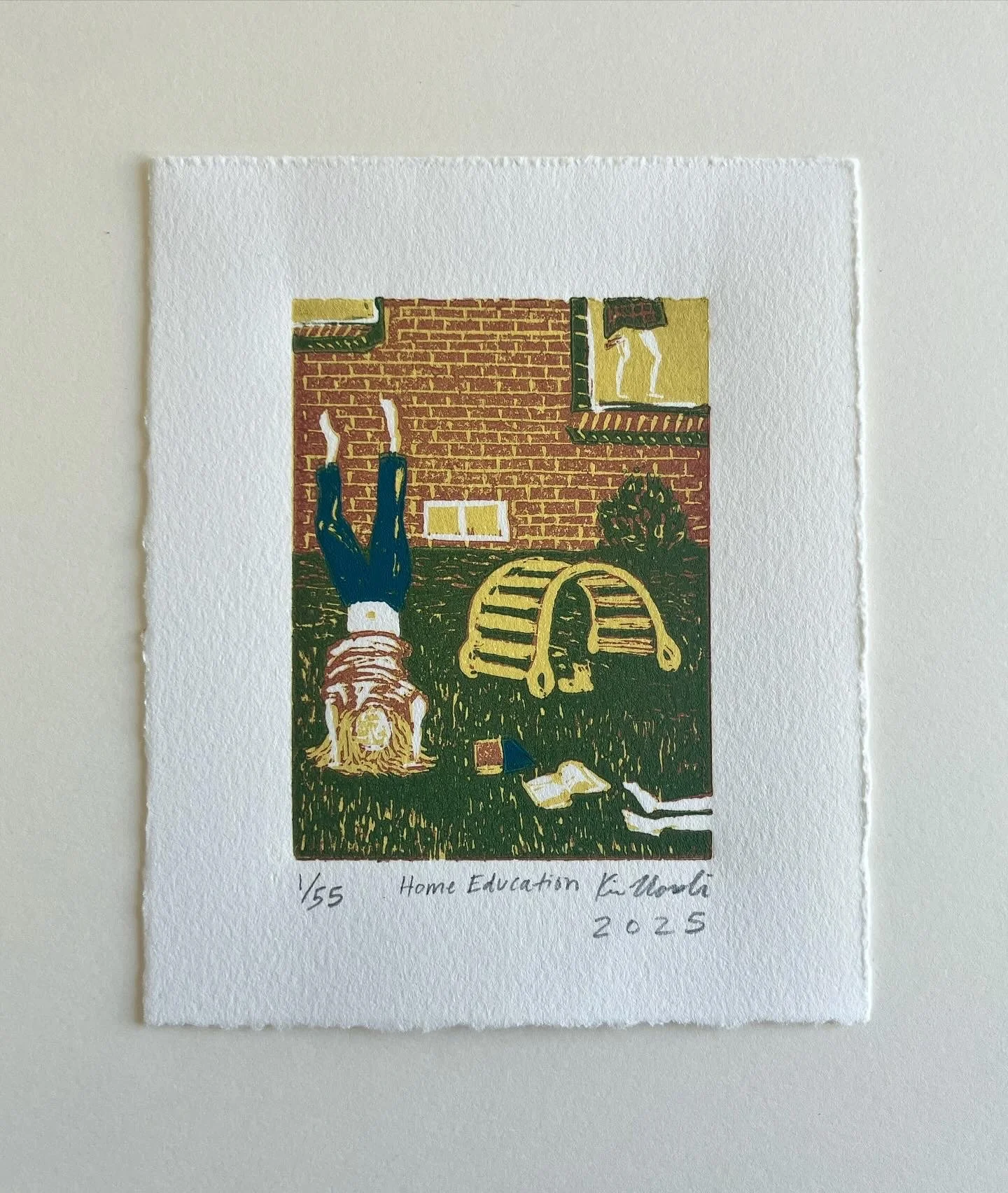
Out of this experience came my print, “Home Education.” When I got to the stage of having three children, ranging from newborn to six, I felt overwhelmed by the feeling of chaos and energy in our home—and I was homeschooling! During that season of being at home all day with my children, I discovered I had not developed important habits of discipline and order in my own life and in our home. I came to the end of myself. My children were holding a mirror up to me, showing me my lack of self-control, patience, and duty, and it was not a pretty sight! Simply put, I realized I was the problem. It wasn’t my children’s behavior, level of energy, or unregulated nervous systems—it was my own, and I had to take responsibility in my own attitudes and actions.
In this way, having children and being at home with them was my education, teaching me how to step into self-responsibility in my health, emotions, and beliefs. With God’s help, through the deep conviction of the Holy Spirit, I began to see my children through totally different, gentle and grace-filled eyes. The title of the print is a pun on homeschooling, but it really speaks to my internal learning process. It is also nod to the philosophy of Charlotte Mason, the Victorian-era educational philosopher in Britain, whose ideas helped reshape my parenting, beginning in our time homeschooling. I highly recommend reading her volume by the same name, “Home Education”.
When I look at this print, I see myself, lying in the yard while my children do headstands and climb in windows. (There was a phase when one of my daughters did headstands more than she was on her feet. I once turned around to find her doing a headstand in a shopping cart.) Am I exhausted and discouraged, or am I taking a minute to breathe deeply and ground myself in the cool grass while we take a break from reading? At one time, the answer would have been the former, but thanks be to God and my children, I can say it’s now more often the latter. Children will teach us, if we let them.

“Home Education” is a limited edition reduction linoleum print. For each color, the block is successively carved away and printed, so all four layers were printed from the same original linoleum block. Once this limited edition of 55 is sold out, that’s it forever!